A sourced chronology
Fire at the Cape, in order
From before the victualling station to the second meat regulation: 18 marks, 36 references. Where the sources disagree — and that is 4 of them — the contradiction stays on the page rather than a number being chosen.
How this list is built
- At least two sources per mark. One source is copied, two are checked against each other.
- Contradictions stay. Where sources give different years, that is said.
- Every mark leads on — to a line, a recipe, a wood or a page. A chronology with no exits is a list.
This line
- Khoikhoi and San before 1652 · dotted
- Trekboers and Voortrekkers 1652 to about 1900 · solid
- Cape Malay from 1658 · long dashes
- British period 1806 to 1961 · double
- Indian Durban from 1860 · short dashes
- Shisa nyama 20th century to today · dash-dot
- Portuguese-Mozambican from the 1970s · fine dashes
- Made at the Cape late 20th century to today · dot-dash
-
before 1652
Fire, pots and dried meat
Khoikhoi and San cook over open fire at the Cape and dry meat in the air. Travel accounts describe hand-built clay pots in which meat was boiled; chemical analysis of Later Stone Age pots from Namaqualand finds milk, meat and marine residues in them.
-
1652
The victualling station at the Cape
The Dutch East India Company sets up a station at the Cape to supply passing ships. The three-legged iron pot arrives with the Dutch and becomes the potjie.
-
from 1658
Enslaved people and their spices
The first enslaved people are brought to the Cape — from Java, Sulawesi, Bengal, the Malabar Coast, Ceylon, Madagascar and East Africa. Turmeric, cardamom, fennel, anise and cinnamon arrive with them in the kitchens out of which Cape Malay cooking grows.
-
1806
The British take the Cape
After the Battle of Blaauwberg the Cape Colony becomes British for the second time, and stays that way. What follows for the grid comes later and quietly: chutney, Worcestershire sauce and the English names of the cuts.
Disputed
The first British occupation ran from 1795 to 1803; only in 1806 did it become permanent. Both dates circulate as the British takeover. -
1834
Emancipation — and the move into the Bo-Kaap
With emancipation many freed people move into the Bo-Kaap, which becomes a predominantly Muslim neighbourhood. The cooking that takes shape there is Cape Malay in its present form.
-
around 1835
Rooikrans arrives at the Cape
The Australian acacia Acacia cyclops is brought to the Cape to stabilise dunes. It spreads across the coastal lowlands and is now the most widespread introduced species there — and the standard braai wood. Burning a bag of rooikrans is conservation and supper at the same time.
Disputed
The accounts vary between the 1830s, 1835 and 1845. Only the purpose and the decade are documented, not the year. -
from 1835
The Great Trek
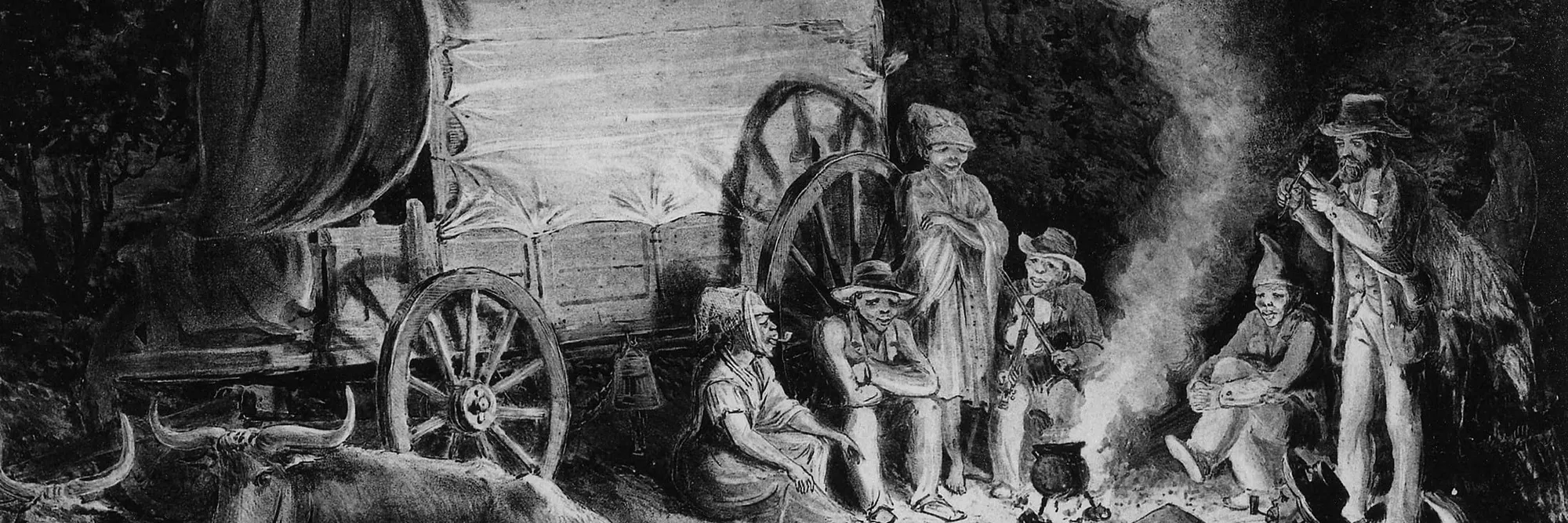
Families leave the Cape Colony by ox wagon for the interior. The potjie hangs under the wagon, protected by a layer of fat, and goes back on the fire at the next stop. Bread without an oven and rusks that keep for months are part of the same calculation.
-
16 November 1860
The Truro docks at Port Natal
The first ship of Indian indentured workers reaches Natal: 342 people from Madras. By 1911 some 152,000 have come. Out of the shops and street stalls of those who stayed on after their contracts comes the bunny chow — and the curry powder now in every South African kitchen.
-
20th century
Butcheries turn into shisa nyama
In the townships butchers begin cooking their meat over coals on the spot at weekends and selling it ready to eat. The sales trick becomes the most widespread public form of braai in the country.
Disputed
There is no founding year. The accounts agree on the starting point — butchery plus weekend — but give no date. -
1957
The Bo-Kaap is fixed by law
The apartheid government declares the neighbourhood a Malay group area and forces everyone else out. Eat in the Bo-Kaap today and you are in a place whose population was set by authority twice — once in 1834 by emancipation, once in 1957 by removing everyone else.
-
1961
South Africa becomes a republic
The country leaves the Commonwealth. The British period formally ends — at the counter the English cut names stay, and in the fridge the chutney stays.
-
1974 to 1976
Peri-peri arrives with the refugees
As Portuguese colonial rule ends, tens of thousands of people come to South Africa from Angola and Mozambique. With them the bird’s eye chilli, the flattened chicken and the garlic, lemon and oil marinade.
-
1976
The gatsby is invented in Athlone
On the Cape Flats a shop owner fills a long roll with chips and leftovers to feed the workmen rebuilding his place. It becomes the sandwich that four people share in Cape Town.
-
23 November 1990
Boerewors gets a regulation
Government Notice R. 2718 sets out what boerewors is: at least 90 per cent total meat content, no more than 30 per cent fat, no offal beyond the casing, no mechanically recovered meat. In force six months after publication. That makes the sausage one of the few foods in the country whose composition is written into the gazette.
-
mid-1990s
24 September becomes Heritage Day
After the end of apartheid, 24 September becomes a public holiday. In KwaZulu-Natal the same day had been Shaka’s Day; when the draft holidays bill left it out, the Inkatha Freedom Party objected, and the day went into the act under a new name.
-
2005
The campaign for Braai Day
Jan Scannell — known as Jan Braai — calls on the country to keep Heritage Day also as National Braai Day: one fire that everybody stands around. The campaign runs as Braai4Heritage.
-
2007 and 2008
Tutu becomes spokesperson — and the council first says no
Archbishop Desmond Tutu takes on the role of national spokesperson for Braai Day in 2007. The National Heritage Council rejects the idea that same year as trivialising, then backs it in 2008.
Disputed
Both names are still in use. Say Heritage Day and you mean the holiday; say Braai Day and you mean the same date with a fire on it — and for some people that is exactly the flattening the council argued against in 2007. -
26 August 2022
The second regulation
Government Notice R. 2410 regulates the classification, packing and marking of raw processed meat products under the Agricultural Product Standards Act — thirteen product categories, boerewors among them. The 1990 rule does not disappear; it gets a frame around it.