Skip to content
Cape Braai

Moves, not recipes

The techniques

9 things you either can or cannot do at a fire. For each: what it is, why it works that way, how you know it is working — and which recipes use it.

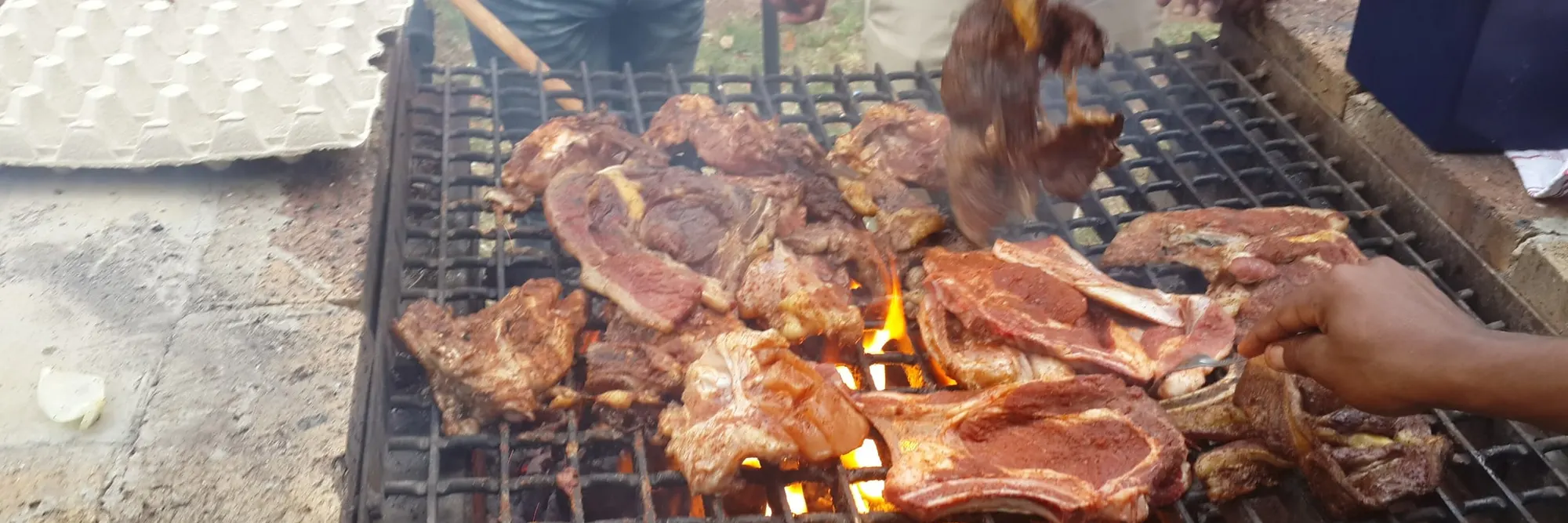
Lamb chops on a large grid with flames coming through from below, two pairs of hands turning them
Thulani Godfrey Timba · CC BY-SA 4.0

The hand-over-grid test

The hand test measures coal heat in seconds: hold your flat hand a hand’s width above the grid and count until you have to pull it away.

Why
Nobody has a thermometer at an open fire, and the colour of the coals says too little. The count is the one reading that works the same everywhere — and it stands on every recipe page here.
How you know
Two seconds is full heat, four is hot, six is medium, eight is gentle. If you fall between two stages, wait for the higher number.

How it goes

  1. Wait until there are no flames left and the coals have a grey coat.
  2. Hold your flat hand a hand’s width above the grid.
  3. Count until it gets too hot. That number is the coal stage.
  4. If it does not match, raise the grid or wait ten minutes — do not fan the coals.

In full on Braai →

Building two zones

Two zones means the coals sit under one half of the grid only, with the other half left clear.

Why
You get two temperatures at once and somewhere to move things when fat drips into the fire. Without a second zone, a flare-up leaves you only the option of taking the meat off.
How you know
Over the hot side you can hold your hand for two to four seconds, over the cool side six to eight.

How it goes

  1. Rake the coals to one half with a shovel or tongs.
  2. Sear on the hot side, then move across and let it come through on the cool side.
  3. Bread and braaibroodjies always belong on the cool side.

In full on Braai →

Cooking indirect

Cooking indirect means there are no coals under the food — the heat comes from the side and from above.

Why
Anything that takes longer than twenty minutes burns on the outside over direct coals before the middle is warm. A whole chicken, thick ribs, a pork belly: all cases for indirect.
How you know
Over the spot where the meat lies you can hold your hand for six seconds or more — even with full coals right beside it.

How it goes

  1. Split the coals to two sides and leave a gap in the middle.
  2. Put the food over the gap, fat side up.
  3. Use a lid or hood if you have one; without it you will need to feed the fire more often.

In full on Braai →

Spatchcocking

Spatchcocking means cutting the backbone out of a chicken so that it lies flat.

Why
A whole chicken is twice as thick at the breast as at the thigh. Laid flat it is roughly even all over and takes about forty minutes instead of an hour and a half — the technique came in with Portuguese-Mozambican cooking.
How you know
The bird lies flat across its whole surface; nothing sticks up and nothing rocks.

How it goes

  1. Cut down both sides of the backbone with poultry shears and lift it out.
  2. Turn the bird over and press the breastbone with the heel of your hand until it cracks.
  3. Skin side up over medium coals; only turn onto the skin at the end.

Watch this

Linked, not embedded — opening this page contacts no outside server. The time marks jump straight to the moment.

Layering in the potjie

Layering means meat at the bottom and everything else stacked above it in order of cooking time — and then you do not stir.

Why
The pot cooks with steam rising from below. Stir and you mix the cooking times, ending up with collapsed vegetables over half-raw meat. Not stirring is not a quirk, it is the method.
How you know
The lid stays on. When it hisses and rattles gently, the pot is working.

How it goes

  1. Brown the meat in the pot until it has colour.
  2. Onions and root vegetables on top, then everything quicker-cooking in layers.
  3. Add very little liquid — the pot should steam, not boil.
  4. Lid on, two to three hours over low coals, and no stirring.

In full on Potjiekos →

Watch this

Linked, not embedded — opening this page contacts no outside server. The time marks jump straight to the moment.

Marinating overnight

Marinating means leaving meat for hours in a mix of acid, fat and spice before it goes on the fire.

Why
The acid — in South African marinades almost always vinegar — loosens the connective tissue at the surface and carries the spice in. Sugar from chutney or apricot jam caramelises later on the grid, which is why marinades like that must never see full coals.
How you know
By the next morning the meat is darker and slightly soft at the surface.

How it goes

  1. Meat and marinade into a bag or a bowl, everything covered.
  2. Overnight in the fridge, four hours at the very least.
  3. Take it out half an hour before it goes on and let it drain.
  4. Brush sugary marinade on in the last few minutes only, or it turns black.

Flare-ups

A flare-up is the flame that shoots up when fat drips off the meat into the coals.

Why
It burns the surface in seconds and then tastes of soot, not smoke. Water makes it worse: it throws up ash and scatters coals.
How you know
There is a sudden sharp smell and flame licking up between the bars.

How it goes

  1. Move the piece aside straight away, onto the cool zone.
  2. Wait for the flame to die by itself — it takes seconds.
  3. Never put it out with water. Frequent flare-ups mean too many coals under meat that is too fatty.

In full on Braai →

Resting

Resting means letting the meat sit for a few minutes after the fire, before you cut it.

Why
In the heat the juice moves inwards. Cut straight away and it ends up on the board — and the piece that was juicy a moment ago is dry.
How you know
If you waited properly, there is no puddle on the board.

How it goes

  1. Off the grid onto a board, not onto a cold plate.
  2. Cover loosely with foil rather than wrapping it — otherwise the crust goes soft.
  3. Five minutes for steaks and sausage, ten to fifteen for large cuts.

Watch this

Linked, not embedded — opening this page contacts no outside server. The time marks jump straight to the moment.

Air-dried, never heated

Drying means treating meat with vinegar and salt and then hanging it in moving air at room temperature — with no heat at all.

Why
The vinegar drops the surface pH, the salt pulls out water; together they leave bacteria nowhere to grow. That is exactly where biltong parts company with jerky, which is sweetened and heated to at least 71 °C.
How you know
It is ready when the piece gives but no longer springs back. Dark red inside is fine — dried does not mean dried through.

How it goes

  1. Cut with the grain, turn in vinegar, season with salt and toasted coriander.
  2. Leave it a few hours, then pat dry.
  3. Hang it on hooks where air moves — no direct sun, no flies.
  4. Three to five days, depending on thickness and humidity.

Watch this

Linked, not embedded — opening this page contacts no outside server. The time marks jump straight to the moment.