Meat · In Afrikaans: Lamspotjie
Lamb potjiekos
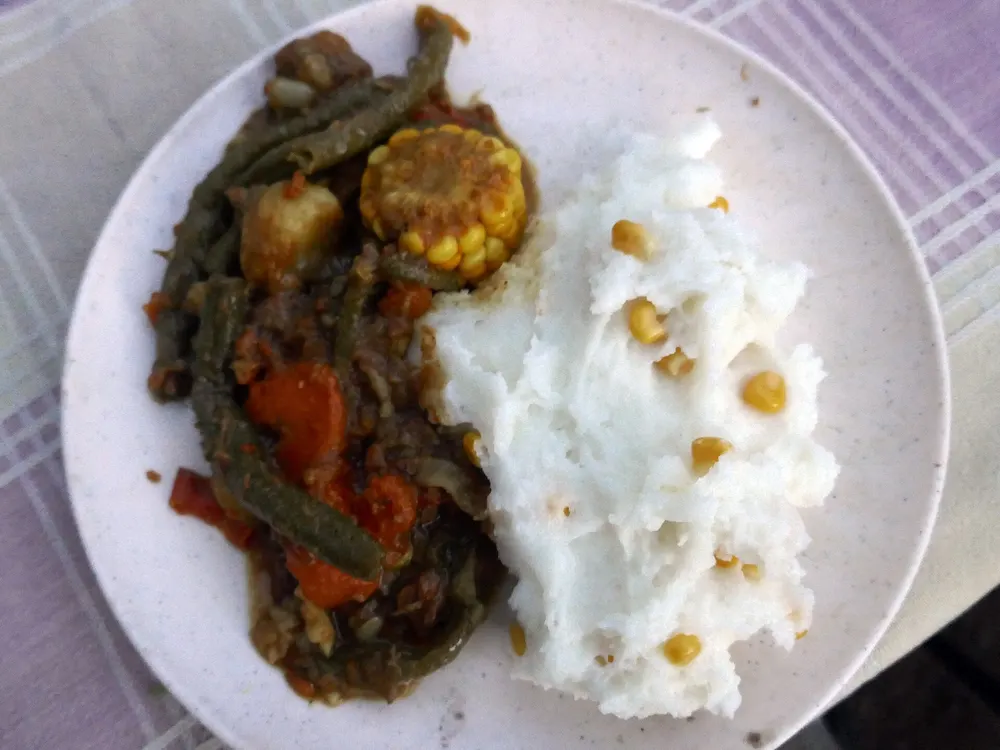
Lamb on the bone, layered vegetables and very little liquid, three and a half hours in a cast-iron three-legged pot over low coals. It does not get stirred — that is not a quirk, it is the method.
The potjie travelled the country with the Voortrekkers and descends from the Dutch iron cooking pot. The three legs have a purpose: the pot stands in the coals, not on a grid. The number on the lid gives the size — a No. 3 at just under eight litres is the usual family pot.
- Prep
- 30 min
- On the fire
- 3 hr 30 min
- Serves
- 8
- Effort
- medium
How hot
Hot
You can hold your hand over the grid for 4 seconds · ≈ 200–230 °C
Every coal stage explained →When it goes on
First on the fire
Goes on first, while the coals are at their hottest — steaks, thick chops, and anything that sits in a pot for hours.
Equipment: Potjie
This line
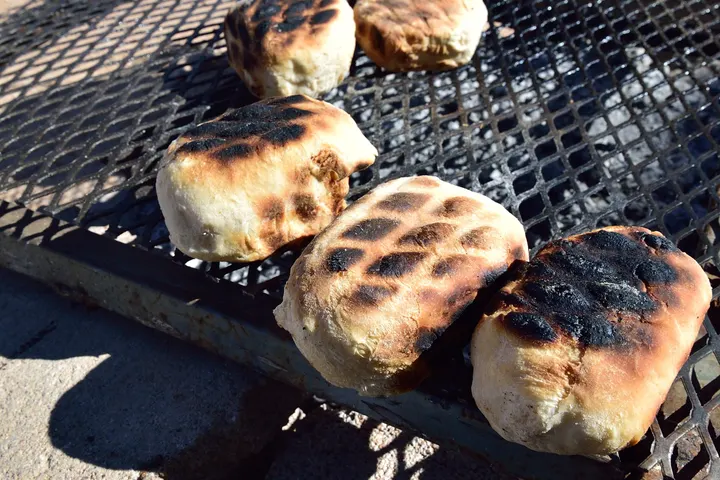
The three-legged pot, sausage as a way of keeping meat, bread without an oven.
Method
-
Get the fire going
Light a wood fire about an hour before you cook and build a proper bed of coals. A potjie needs steady coals for hours — which is why kameeldoring is the right wood here and rooikrans the wrong one.
-
Brown the meat
Heat the oil in the pot and brown the lamb hard, in batches, then take it out. In a crowded pot it steams instead of browning, and the dark crust is half the flavour.
-
Onions and spices
Soften the onions in the fat, add garlic and ginger briefly. Stir in coriander, cumin and chilli and toast for a minute in the fat, then add the tomato paste and let it darken slightly.
-
Deglaze and close
Deglaze with the wine and stock, scraping the base. Return the meat, add the herbs, season. Lid on, and cut the coals down to a third — the pot should mutter, not boil.
-
Two hours undisturbed
For two hours, lift the lid only occasionally to check the liquid level. Every 30 to 40 minutes add a log or two and rake the fresh coals under the pot.
-
Layer the root vegetables
Lay potatoes, carrots and butternut on top of the meat without stirring. The liquid should not cover them — they cook in the steam rising from below. Lid on, another hour.
-
Soft vegetables on top
Add mushrooms, beans and peas as the top layer. Another 20 to 30 minutes until everything is tender.
-
Reduce uncovered
Take the lid off and simmer for 15 to 20 minutes until the sauce has thickened. Only now lift everything through once, gently from the bottom up, taste, and serve straight from the pot.
Tips
- Not stirring is the one rule that counts. Stirring destroys the layers, presses the vegetables into the sauce and ends the browning at the base.
- There is less liquid than you expect. The pot should steam, not boil — so it never gets topped up until things are covered.
- Lamb wants three and a half to four hours. Beef is quicker, chicken much quicker — swap the times without adjusting the layers and you get mush.
- It works on a stove too: lowest heat, a heat diffuser, the same times. You lose the smoke and nothing else.
A potjie is not a stew, even if it looks like one at the end. The difference is that the ingredients never get mixed: browned meat sits at the bottom in a little liquid, root vegetables above it, soft vegetables on top. The steam rises through the layers, carries flavour upwards and leaves each layer to itself.
Stir it and you have made a stew. That tastes fine, but it tastes the same everywhere — and the crust on the base, where the dark note comes from, ends up dispersed in the sauce instead of staying put.
The second point is the fire. A potjie stands in the coals, not over them, and it needs three and a half hours of them. Rooikrans is too short-lived for that; you would be feeding it every twenty minutes. Kameeldoring or black wattle hold, and that is exactly why every recipe on this site names the wood it means.
Where it comes from
- Where the word comes from
- Afrikaans · Literally „pot food“ *Potjie* is the diminutive of *pot* — a No. 3 still holds nearly eight litres.
The three-legged iron pot came to the Cape with the Dutch and goes back to the European stewing pot. What changed it here was not the kitchen but the movement: from 1835 families left the Cape Colony by ox wagon for the interior, and the cooking gear had to travel.
That explains everything awkward about it. Three legs so it stands in the coals without a frame. Cast iron because it survives knocks. The layer of fat it hung under the wagon in, so it would not rust. A pot that was equipment, not kitchenware.
The method came out of the same arithmetic. Cooking on the move you have little liquid, little firewood and no second pan. So you layer instead of stirring: the meat that needs hours at the bottom, whatever cooks faster above it; the steam rises and cooks each layer from below. Not stirring is not a quirk but the answer to a pot that heats from underneath.
What is different today is the occasion. A potjie is no longer cooked because you must, but because it takes three hours. Those three hours have become the point.
Watch this
Linked, not embedded — opening this page contacts no outside server. The time marks jump straight to the moment.
12:44
English
ChilliChump
Potjiekos: South African Cast-Iron Pot Stew (How To)
Explains not stirring as a method rather than a quirk — exactly where most guides stop.
- 3:10„Brown the meat“ — Browning in the pot — the only moment when anything in a potjie gets stirred.
- 8:35„Why you don't stir potjiekos“ — The heart of it, and why a potjie is not a casserole. Nobody else gives that its own chapter.
Last checked 2026-09-05
18:57
English
Travel Trails Tastes
This Lamb Neck Potjie Is the Best Comfort Food Ever
Lamb neck is the cheap cut that works best in a potjie. The video makes it visible why the order of the layers is not decoration.
- 1:27„Braaing the Lamb“ — The meat goes on the fire before it goes in the pot — a step many recipes leave out.
- 10:10„Layering the Potjie the Right Way“ — The layering shown as a step of its own, from the bottom up.
Last checked 2026-09-05
14:13
English
Travel Trails Tastes
Epic South African Springbok Potjie | Slow-Cooked Over a Campfire
Springbok is an ordinary cut in a South African supermarket. The video treats it that way instead of making an event of it.
- 0:34„Browning the Meat“ — Game in the pot: lean meat that behaves differently from lamb.
- 5:02„Slow Cooking Over the Coals“ — The pot over open coals rather than on a gas burner — the difference shows in how the heat is managed.
Last checked 2026-09-05
Goes with this
Side · Pap
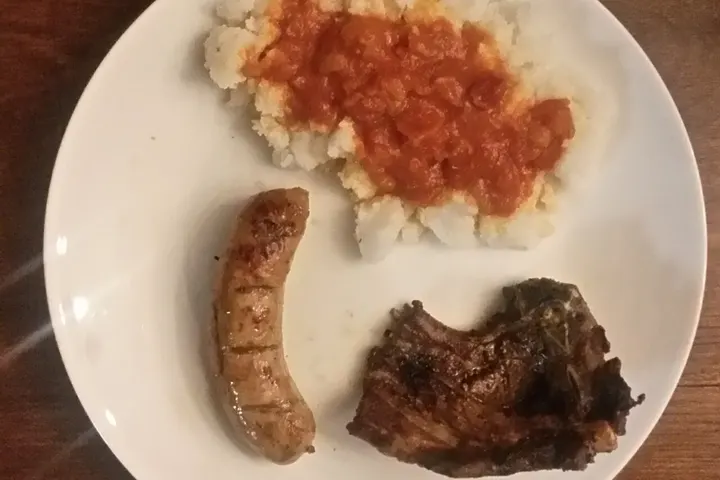
Pap — stywe pap and krummelpap
Side · Biltongslaai