Monograph
Potjiekos
A pot on three legs, three hours, and one rule: do not stir. Where the pot comes from, which size suits how many people, why the layering is the method — and the five mistakes everyone makes.
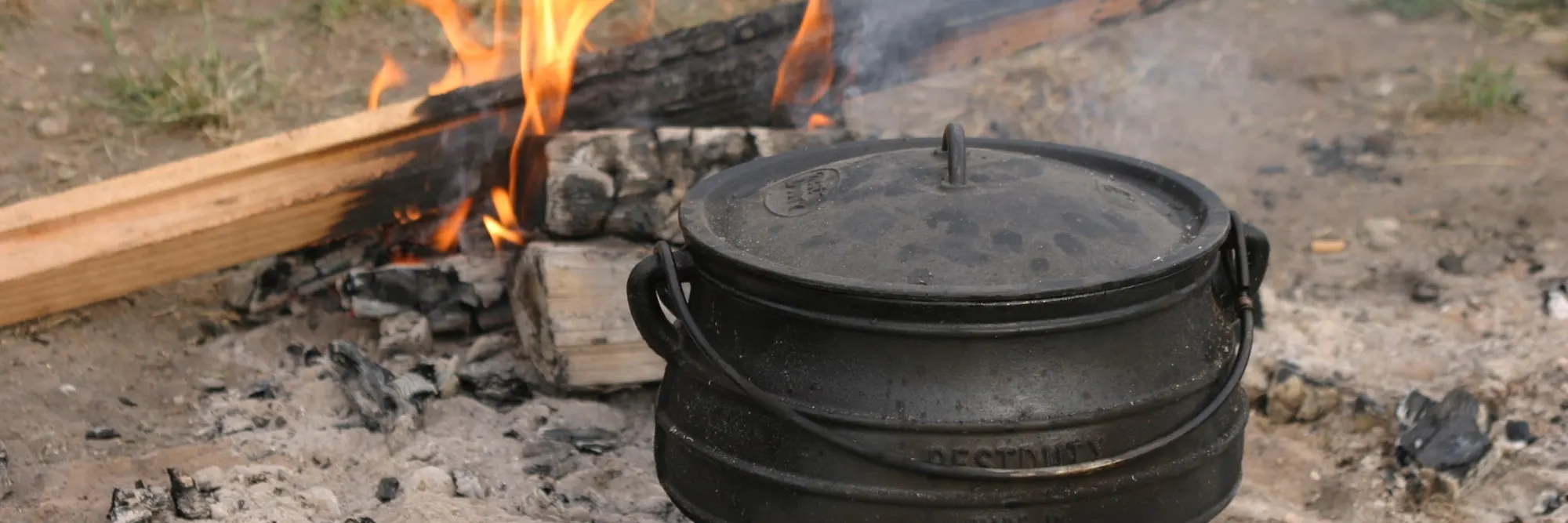
The pot
The three-legged cast-iron pot came to the Cape with the Dutch and goes back to the European stewing pot. The three legs have a purpose that is often missed today: the pot stands in the coals, not on a frame above them. The heat comes from below and from the sides.
During the Great Trek from 1835 it hung under the ox wagon, protected from rust by a layer of fat, and went back on the fire at the next stop. That is the reason for everything heavy and awkward about it: it was equipment, not kitchenware.
Potjiekos means pot food, literally. It refers not only to the dish but to the afternoon that goes with it.
Sources
The sizes
The number is not a litre count. No. 3 is the usual size for a group, No. 2 for a family. A potjie wants to be at least two-thirds full — the pot cooks with steam, and at half full there is not enough of it.
| Number | Holds | Serves |
|---|---|---|
| Nr. 1 | ca. 2 l | 2–4 |
| Nr. 2 | ca. 5 l | 4–6 |
| Nr. 3 | ca. 7,8 l | 8–12 |
| Nr. 4 | ca. 4 l | 6–8 |
| Nr. 6 | ca. 6 l | etwa 10 |
Why you do not stir
The pot cooks with steam that rises from below and runs back down off the lid. So the meat that needs hours goes at the bottom, the root vegetables above it, and everything quicker on top. Each layer is steamed by what lies under it.
Stir and you mix the cooking times. The result is collapsed vegetables over half-raw meat — and liquid catching at the bottom, because the meat has been stirred up. Not stirring is not a quirk; it is the method.
Very little liquid goes in. The pot should steam, not boil. When the lid hisses and rattles gently, it is right.
Layering in the potjie · Potjie
Seasoning and care
A new pot gets seasoned: wipe it thinly with oil, heat it over coals until it smokes, let it cool, repeat. That builds the black, smooth layer you must not scrub off.
After use, rinse it hot with no detergent, wipe it dry and oil it lightly. Never leave it standing overnight with water in it — cast iron rusts in hours, not weeks.
Rust is not a death sentence. Sand it back, season it again, carry on. A potjie outlasts whoever bought it.
The five most common mistakes
-
Too much liquid
The stew becomes soup and the layering floats apart. Add until it is moist, not until it is covered.
-
Too much fire
It catches at the bottom and nothing is done on top. A potjie wants a small, quiet fire you feed rather than build.
-
Lifting the lid
Every time, the steam that does the cooking escapes. Once after two hours is plenty.
-
Stirring
See above. It is the one move that ruins the dish.
-
Too little in the pot
Below two-thirds full there is not enough steam. Better a size down than a big pot half full.
Watch this
Linked, not embedded — opening this page contacts no outside server. The time marks jump straight to the moment.
12:44
English
ChilliChump
Potjiekos: South African Cast-Iron Pot Stew (How To)
Explains not stirring as a method rather than a quirk — exactly where most guides stop.
- 3:10„Brown the meat“ — Browning in the pot — the only moment when anything in a potjie gets stirred.
- 8:35„Why you don't stir potjiekos“ — The heart of it, and why a potjie is not a casserole. Nobody else gives that its own chapter.
Last checked 2026-09-05
18:57
English
Travel Trails Tastes
This Lamb Neck Potjie Is the Best Comfort Food Ever
Lamb neck is the cheap cut that works best in a potjie. The video makes it visible why the order of the layers is not decoration.
- 1:27„Braaing the Lamb“ — The meat goes on the fire before it goes in the pot — a step many recipes leave out.
- 10:10„Layering the Potjie the Right Way“ — The layering shown as a step of its own, from the bottom up.
Last checked 2026-09-05
12:39
English
Wolkberg Artisans
How to make a South African OXTAIL Potjie Recipe | Cast Iron Cooking
Shows pot and meat large and unhurried before anything happens. Useful if you are standing in front of a potjie for the first time.
- 1:13„This is called a 'Potjie'“ — The pot on screen, three legs and a rounded belly. If you have never seen one, this is where you see why it looks like that.
- 1:40„Oxtail“ — The cut itself — connective tissue, bone, fat. This is what tells you at the counter whether it is any good.
Last checked 2026-09-05
19:29
English
Travel Trails Tastes
Fall-Off-The-Bone Oxtail Recipe | South African Potjie Method
Pairs oxtail with umngqusho rather than potatoes — the combination people actually eat at the Cape.
- 10:10„Slow Cooking the Potjie“ — The hours in which nothing happens — and how small the fire has to be for them.
- 12:13„Preparing the Samp & Beans“ — Samp and beans alongside: the dish that belongs with it in South Africa, in the same video.
Last checked 2026-09-05