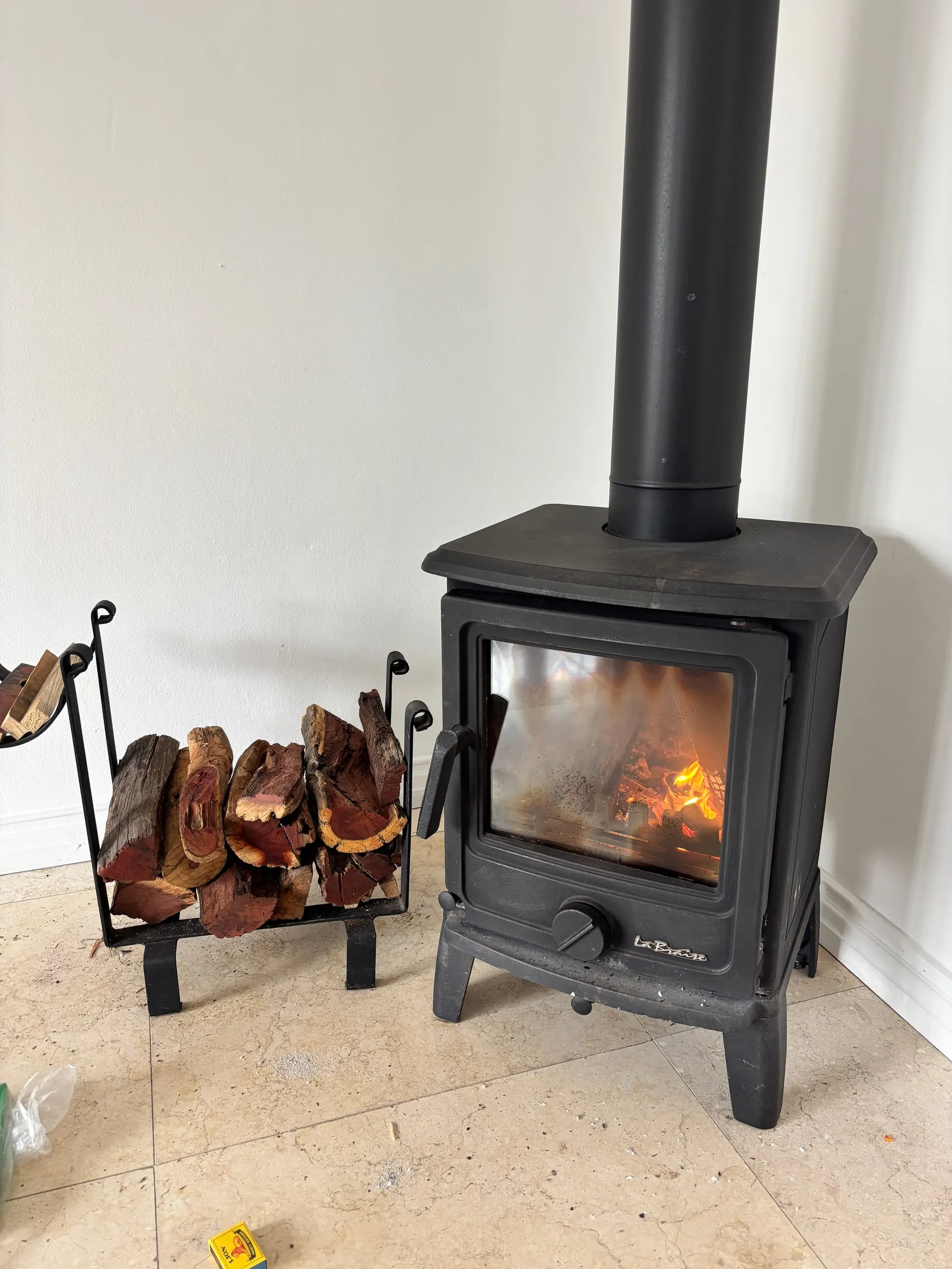
Fire indoors
A fireplace wants the other wood
At the Cape you braai outside and heat inside — and the two want different wood and a different approach. A braai fire should make coals fast and is allowed to smoke. A fireplace fire should burn long and is emphatically not.
The one thing to change
Light it from the top, not the bottom
The campfire principle — paper below, wood above — is the wrong one indoors. In an upside-down build the heavy logs go at the bottom and the firelighter on top. The fire works its way downwards, and the gases rising off the lower logs pass through the flame above and burn there instead of leaving as smoke up the flue.
-
Heavy logs at the bottom
Two or three large logs side by side on the floor of the firebox. Side by side means no gaps for coals to drop through later.
-
Medium logs crosswise
A second layer, turned ninety degrees. It catches once the layer above heats it.
-
Kindling on top
A generous layer of thin, dry kindling — pine is exactly right here. One or two firelighters on top of that.
-
Light the top, close the door
Light only the topmost firelighter. Then add nothing until the bottom layer is burning. Every opening cools the chamber.
Top to bottom
The fire burns downwards. Which is why nothing gets added at first.
Control
Air is the only dial you have
A fireplace has no temperature setting, only air. While lighting, the intake stays wide open so the flue warms and draws. Once the bottom layer is burning, close it far enough that the flame stands still — but never so far that the fire only smoulders. That smouldering is the cause of nearly everything that goes wrong: cold smoke, blackened glass, deposits in the flue.
Three things that go wrong
Smoke in the room
Almost always a draw problem, not a wood problem: the flue is still cold, or there is no make-up air because the house is too airtight. The remedy is a small hot fire first to get the draw going, and if in doubt a window in the same room opened a crack.
Blackened glass
The glass blackens when the fire burns too cool or the wood is too wet. A sticky, tarry film is a warning sign — the same thing is settling in your chimney.
Spitting sparks
A softwood issue, pine above all: resin pops as it burns and throws embers. An open fireplace wants a spark guard, or hardwood only.
The one test
Checking moisture — by ear
Properly seasoned firewood sits below 20 percent moisture. Freshly felled wood can be half water by weight. That water has to evaporate before anything else happens, and the energy it takes is heat you do not get — so the fire runs cool, smokes and deposits in the flue.
-
Knock two logs together: dry wood rings bright and hollow, wet wood sounds dull and heavy.
-
Look at the cut end: dry wood shows cracks running out from the centre.
-
Weigh it in your hand: the same log is noticeably lighter when dry — water weighs something.
-
To be certain, buy a moisture meter. Under 20 percent is the mark.
What does not belong in a fireplace
Treated wood
Painted, impregnated, glued, stained: pallets, chipboard, old window frames. Burning them produces things that should not be in a living room and residues that ruin the flue.
Driftwood
It looks lovely and it is soaked in salt. Salt attacks the firebox lining and the chimney.
Freshly cut wood
Green wood belongs under a roof, not in a fire. One to two years stacked with air on every side.
Pine as your main fuel
Not because of the resin — the creosote argument does not hold as usually told. Because it burns down too fast, forces constant refuelling and spits. For lighting it is unbeatable.
The wood for indoors
Three types qualify, three are excluded with reasons given. The full comparison with heat, coal life, smoke and price is on the wood page.
Goes in
- Kameeldoring First choice. Dense, very dry, a calm flame, hardly any smoke, little ash — load it once and you have two quiet hours. The only reservation is provenance, not how it burns.
- Black Wattle The sensible choice. Well dried, black wattle burns long and evenly, it is cheap and available everywhere. It smokes a little more than kameeldoring but far less than rooikrans — and it is the main component of a kaggelhout mixed bag anyway.
- Kaggelhout The standard option. Denser and drier than braai wood, little smoke, little ash, affordable. If you are not buying kameeldoring specially, buy this.
Not in a fireplace
- Rooikrans Not for the fireplace. Rooikrans is almost always sold only part-dried — the bag is meant for a grid, where the smoke goes away. Indoors that same residual moisture means heavy smoke, a sticky film on the glass and deposits in the flue. Several of the bigger Cape merchants disagree and list rooikrans for indoor use — usually kiln-dried stock. That is the distinction that matters: properly dried yes, the ordinary supermarket bag no.
- Sekelbos Technically fine, but not worth it. Sekelbos is dry enough and smokes little — but you pay bushveld prices for heat a mixed bag delivers just as well. And the sweet aroma that is the whole point at a fire is not what you want in a living room every evening. Some merchants list it as fireplace wood anyway.
- Kiefer With reservations only. Not because of the resin — the creosote argument as usually told is wrong. Because it burns down too fast, forces constant refuelling and spits in an open fireplace. Ideal for lighting, wrong for the evening.
Sources
And outside? A braai fire follows different rules →