Skip to content
Cape Braai

Firewood at the Cape

Which wood for the braai and the fireplace?

A braai and a fireplace want different wood — and that distinction is nowhere set out properly online. Here it is: what makes coals quickly, what burns long and quietly, and which wood does not belong indoors, with the reason.

All six compared

Heat, coal life and smoke as comparative values from 1 to 5, not measurements. For smoke, 1 is little and 5 is a lot. Sources are listed with each wood.

WoodHeatCoal lifeSmokeAromaBraaiFireplace
Rooikrans 4/5 3/5 3/5 spicy, resinous yes no
Sekelbos 5/5 4/5 2/5 sweet, aromatic yes no
Kameeldoring 5/5 5/5 1/5 subtle, dry yes yes
Black Wattle 3/5 4/5 3/5 smoky, assertive yes yes
Kaggelhout 4/5 4/5 2/5 neutral to lightly smoky no yes
Kiefer 3/5 1/5 4/5 resinous, sharp no no
Invasive — burning it helps Braai Not in a fireplace

Rooikrans

Acacia cyclops

The Western Cape default. Quick to temperature, very hot coals that fade sooner than the denser woods.

Rooikrans is what most braais at the Cape run on, for a practical reason: after roughly 40 minutes you have coals hot enough for wors and chops. They do not last forever, though — perfect for a 45-to-60-minute braai, wrong for a three-hour potjie.

The acacia originally comes from Australia and has spread along the coast to the point of crowding out indigenous fynbos. Burning rooikrans is, in that sense, conservation work with dinner as a side effect.

Not in a fireplace

Not for the fireplace. Rooikrans is almost always sold only part-dried — the bag is meant for a grid, where the smoke goes away. Indoors that same residual moisture means heavy smoke, a sticky film on the glass and deposits in the flue. Several of the bigger Cape merchants disagree and list rooikrans for indoor use — usually kiln-dried stock. That is the distinction that matters: properly dried yes, the ordinary supermarket bag no.

Buying it

Sold in supermarkets as "Bush Baby Rooikrans" in 7 kg bags; cheaper per kilo from firewood merchants, especially if you buy split logs by the bag rather than pre-packed.
Sources
Unproblematic Braai Not in a fireplace

Sekelbos

Dichrostachys cinerea

The driest firewood you can buy. Very high heat and smoke that works like a spice.

Sekelbos is traded less as fuel than as flavour. The wood dries down in the bushveld sun to far below the mark at which firewood counts as seasoned — merchants advertise one to three percent, which is lower than air-dried wood can actually hold, but the direction is right. On top of that it carries aromatic oils that release a distinctly sweet smoke as it burns.

That makes it the opposite of a neutral wood. Sear a steak quickly and you will barely notice. Keep poultry or pork belly over the coals for longer and the difference is obvious.

Not in a fireplace

Technically fine, but not worth it. Sekelbos is dry enough and smokes little — but you pay bushveld prices for heat a mixed bag delivers just as well. And the sweet aroma that is the whole point at a fire is not what you want in a living room every evening. Some merchants list it as fireplace wood anyway.

Buying it

Pricier than rooikrans and not stocked everywhere. Worth it for longer cooks — on quick wors the aroma is wasted.

Sources
Protected species — check the origin Braai Fireplace

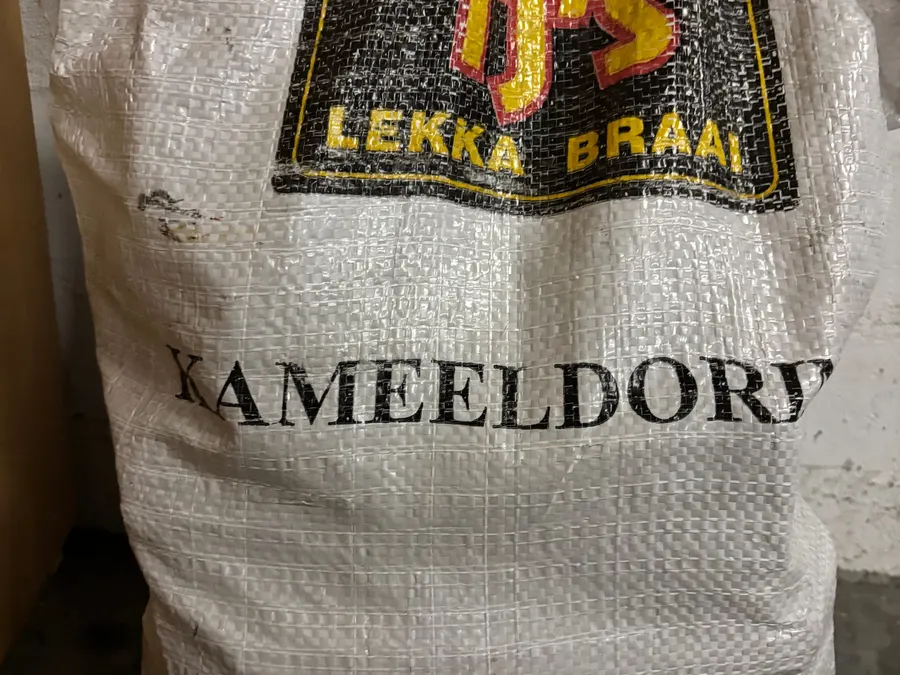
Kameeldoring

Vachellia erioloba

Rock-hard, extremely dense, burns for hours with a calm flame and little smoke. Southern Africa's best fireplace wood — and the legally trickiest.

Kameeldoring is the benchmark other firewood is measured against: dense, heavy, near bone-dry, with a flame that stands still and coals that carry for hours. In a fireplace that means loading once instead of feeding constantly, and barely any smoke in the room.

The catch is legal. The tree grows extremely slowly and is listed as a protected species under South Africa's National Forests Act. Cutting living trees without a permit is an offence. What is legally on the market almost always comes from Namibia, where camel thorn is farmed for the purpose, or from demonstrably dead trees.

Fireplace

First choice. Dense, very dry, a calm flame, hardly any smoke, little ash — load it once and you have two quiet hours. The only reservation is provenance, not how it burns.

Buying it

Only buy from a merchant who states the origin — "Namibian Kameeldoring" is the usual marker for legal stock. Suspiciously cheap wood at the roadside: walk away.

Sources
Invasive — burning it helps Braai Fireplace

Black Wattle

Acacia mearnsii

Softer than the other hardwoods, but cheap, available everywhere, and good for long, even coals.

Black wattle is the workhorse. It is softer than rooikrans or kameeldoring, so it catches faster and lights a fire well — yet it holds a surprisingly long, even bed of coals and gives meat a pronounced smoky note.

This acacia is introduced too and counts as invasive in South Africa because it draws enormous amounts of water along riverbanks. Burning it is as uncontroversial as burning rooikrans.

Fireplace

The sensible choice. Well dried, black wattle burns long and evenly, it is cheap and available everywhere. It smokes a little more than kameeldoring but far less than rooikrans — and it is the main component of a kaggelhout mixed bag anyway.

Buying it

The cheapest of the four. If you are unsure where to start: here — with a bag of rooikrans alongside.

Sources
Invasive — burning it helps Fireplace

Kaggelhout

Mischung, meist Acacia mearnsii, Eucalyptus spp., Casuarina

Not a species but a mix — the bag that says "kaggelhout" on the shelf. That is exactly the stuff for a fireplace.

Kaggelhout is simply Afrikaans for fireplace wood and names no species. The bag usually holds blue gum, black wattle, red gum, beefwood and Port Jackson — all of it from the clearing of invasive stands, cut denser and drier than braai wood.

That is why the split between braai wood and fireplace wood is visible on the shelf at all: two different bags with two different labels, and one is not the other.

The catch: "semi-seasoned" means part-dried at most merchants, not bone-dry. A bag that has stood two weeks under cover burns noticeably better than one straight off the delivery.

Fireplace

The standard option. Denser and drier than braai wood, little smoke, little ash, affordable. If you are not buying kameeldoring specially, buy this.

Buying it

The bag for the fireplace, not the grid. Read the label — braaihout and kaggelhout sit on the same shelf and are not the same thing.

Sources
With reservations Not in a fireplace

Kiefer

Pinus spp.

Cheap, available everywhere, burns fast and hot — and is still the wrong wood for both jobs. As kindling, unbeatable.

Pine is a softwood with a high resin content. It catches immediately, burns hot and is gone in twenty minutes, leaving hardly any coals. For a braai that means you can light with it but not cook on it.

On the fireplace question a correction is due. The common story is that the resin deposits creosote in the flue. The research says otherwise: creosote comes mainly from **cool burning and wet wood**, not from the species. Dry pine burnt hot deposits no more than dry hardwood.

It is still listed here as unsuitable, for two practical reasons. It burns down so fast that you refuel every twenty minutes — and constant refuelling never lets the flue settle at a proper temperature. And it spits. In an open fireplace that is not a theoretical concern.

Not in a fireplace

With reservations only. Not because of the resin — the creosote argument as usually told is wrong. Because it burns down too fast, forces constant refuelling and spits in an open fireplace. Ideal for lighting, wrong for the evening.

Buying it

One small bag as kindling lasts a season. As your main fuel it is cheap to buy and expensive to use.

Sources

Common questions

Which wood do people in Cape Town use for a braai?
Rooikrans is the default: usable coals after about 40 minutes, and the 7 kg bag is in every supermarket. For long cooks such as a potjie, kameeldoring or black wattle is the better choice because the coals last.
Can rooikrans go in a fireplace?
Better not. Rooikrans is usually sold only part-dried; indoors that means heavy smoke, a sticky film on the glass and deposits in the flue. For a fireplace use kaggelhout, black wattle or kameeldoring.
Is kameeldoring legal to buy?
The tree is a protected species under South Africa’s National Forests Act; cutting living trees without a permit is an offence. Legal stock almost always comes from Namibia or from demonstrably dead trees. Only buy where the origin is stated.
Does pine really cause creosote in the chimney?
Not the way it is usually told. Creosote comes mainly from cool burning and wet wood, not from pine resin. Burnt dry and hot, pine deposits no more than hardwood. It is still unsuitable: it burns down too fast, forces constant refuelling and spits in an open fireplace.
What is the difference between braaihout and kaggelhout?
Two bags on the same shelf with two labels. Braaihout is mostly rooikrans, made for fast, hot coals. Kaggelhout is a denser, drier mix — usually blue gum, black wattle, red gum, beefwood and Port Jackson — meant for a fireplace.
How do I tell whether wood is dry?
Knock two pieces together: dry wood rings bright and hollow, wet wood sounds dull. It is a rough test but the only one you have in the shop. To be sure, use a moisture meter — under 20 percent is the mark.

And where do you buy it?

Short answer: at the supermarket. A bag costs between 59 and 69 rand practically everywhere in Cape Town — comparing prices is not worth it, choosing the right type is. Which bag for which fire, how to spot dry wood and where to find more than one type is on the buying page.

See the shelf card
A woven bag labelled Kameeldoring, packed by TJ's Lekka Braai
Own photograph, Cape Town

Watch this

Linked, not embedded — opening this page contacts no outside server. The time marks jump straight to the moment.