Monograph
Biltong
Air-dried meat with vinegar, salt and coriander — and expressly not jerky. Where the difference comes from, how to cut it, what the box does, when it is done, and why you may not carry it home in a suitcase.
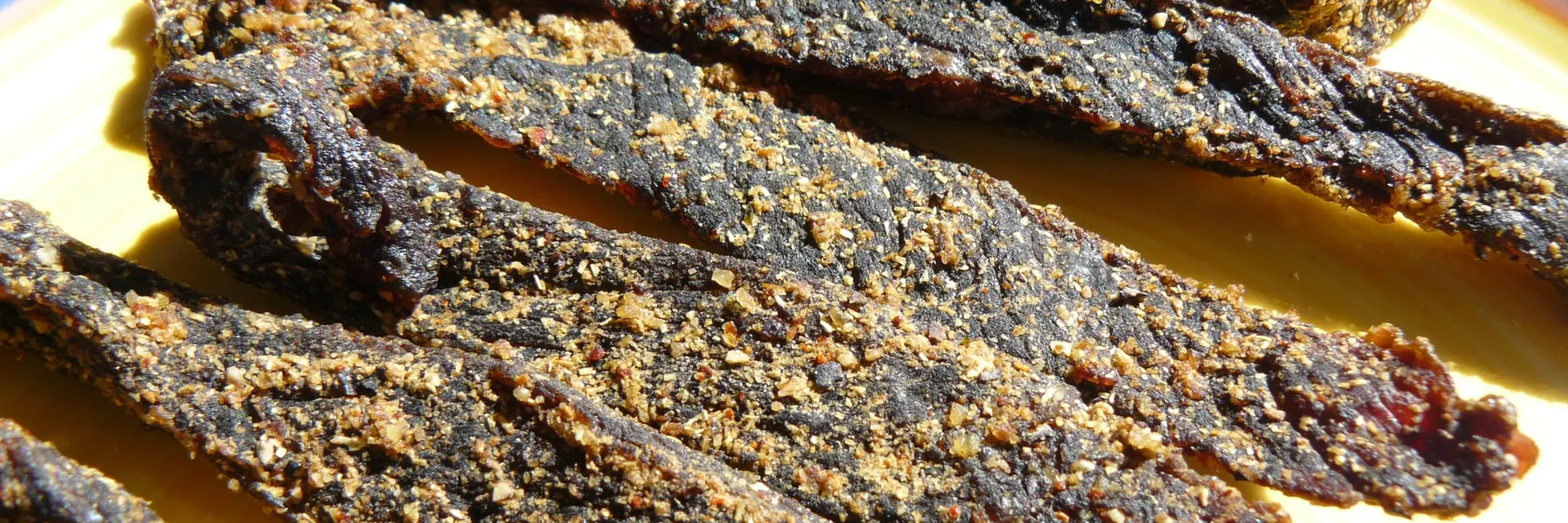
Biltong is not jerky
The two words get used interchangeably. They are two different processes with two different results.
| Feature | Biltong | Jerky |
|---|---|---|
| Preservation | vinegar and salt | salt and sugar |
| Heat | none — room temperature, moving air | heated, at least 71 °C |
| Cutting | dried whole, sliced afterwards | sliced into strips before drying |
| Seasoning | coriander, pepper, salt | usually sweet, often smoked |
| Result | softer, saltier, dark red inside | drier, chewier, the same throughout |
What the vinegar and salt do
The vinegar drops the pH at the surface, the salt pulls out water. Together they leave bacteria nowhere to grow without any heat being needed — that is the trick, and it is why biltong is never cooked.
The method is older than the word. Cutting meat into strips, salting it and hanging it in the air was practice at the Cape before the settlers arrived; what they added was vinegar.
Air-dried, never heated · Khoikhoi and San
Which way to cut
Cut with the grain, not across it. Meat cut across falls into short fibres as it dries; cut lengthways it holds together and can be sliced across later — which is the direction you can actually bite.
Thickness: about two centimetres. Thinner dries through fast and goes hard, thicker takes longer than the humidity allows.
Box or window
At the Cape a draughty spot at an open window does it in the dry months, with a net against flies. That is the classic way, and it works because the air is dry.
In Europe it does not work. Above about 60 per cent humidity the meat cases over on the outside and spoils inside. Then you need the box: hooks, a small fan, a light bulb as a heat source — not to cook, but to move the air and warm it slightly.
Sun is not part of it. Direct light hardens the surface and turns the fat rancid.
When it is done
By feel: the piece gives but no longer springs back. Dark red inside is fine — dried does not mean dried through, and waiting until it snaps gets you a hard biscuit.
By weight: the most reliable measure is weight loss. Weigh the pieces before hanging them and you can work it out later instead of guessing. Three to five days is the range, depending on thickness and humidity.
Keeping: properly dried biltong keeps for weeks at room temperature, stored with air around it. In a sealed bag it sweats and moulds. A paper bag beats any tin.
Bringing it into the EU
Short answer: you cannot. Regulation (EU) 2019/2122 prohibits carrying meat and meat products from non-EU countries in personal luggage. The reason is animal disease — foot-and-mouth, African swine fever — not the quality of South African product.
That covers a packet in hand luggage and it covers gifts. Try it and you risk confiscation and a fine.
What does work: biltong made inside the EU. The process is the same, the raw material comes from here. Addresses are in the ingredients reference.
Sources
- Verordnung (EU) 2019/2122 — Reisegepäck: Einfuhr von Erzeugnissen tierischen Ursprungs
- Zoll — Bestimmungen für die Einfuhr tierischer Erzeugnisse
Checked on 2026-09-05
Watch this
Linked, not embedded — opening this page contacts no outside server. The time marks jump straight to the moment.
37:20
English
Coldsmoking Digital Cookery School
5 DAY Biltong - Full Tutorial - PLUS Building a Biltong BOX
The only run-through we found that measures the drying instead of estimating it — with scales, over five days.
- 3:53„Curing“ — Vinegar and salt — the step that preserves biltong without any heat involved.
- 7:54„Biltong Box“ — The box being built. In Europe it is not an accessory but a requirement — the humidity rules out an open window.
- 27:28„Drying Analysis“ — Weight loss as the measure of done. That is the answer to the question every biltong recipe leaves open.
Differs from us
The channel works with curing salt. At the Cape the classic route is sea salt, vinegar and coriander only; so is our recipe.Last checked 2026-09-05
21:07
English
Biltong Depot
How to Make Biltong at Home Using Grocery Store Meat
Starts from what an ordinary supermarket has, rather than a special cut from a butcher.
- 2:08„Cutting the Meat“ — Which way you cut. With the grain or across it decides whether you later bite or tear.
- 9:42„Adding the Vinegar“ — How much vinegar actually goes on — the amount recipes like to dismiss as a splash.
- 15:54„Testing the Biltong“ — The finger test: it should give, not spring back.
Last checked 2026-09-05
20:32
English
Burning Speares
The Easiest and Best Way to Make South African Biltong
Shows the steps in the order you actually do them, without cutting away.
- 8:19„Salting“ — Salting as a step of its own, before the vinegar — the order the recipes argue about.
- 10:21„Soak in Vinegar“ — Dipping rather than brushing. You can see how short the bath is.
- 14:22„Hanging“ — Spacing between the strips. Where they touch they do not dry, and that is where they spoil first.
Last checked 2026-09-05