Snack
Biltong
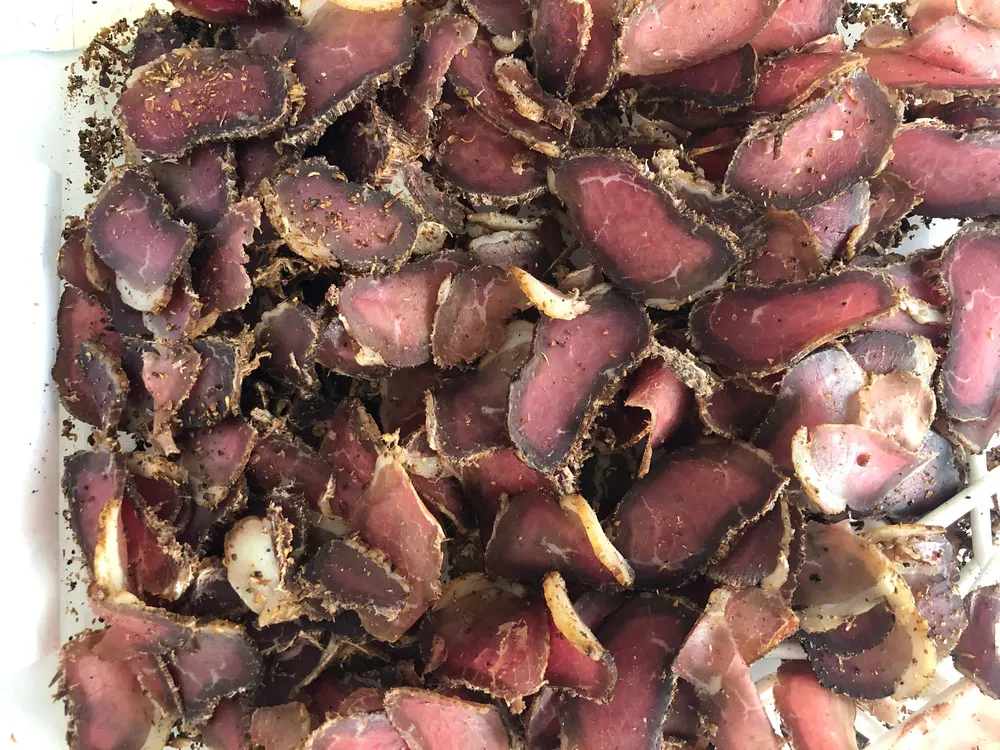
Beef in strips, steeped in vinegar, seasoned with toasted coriander and coarse salt and air-dried for three to six days. No fire involved — and still the most South African thing here.
Biltong is older than any recipe on this site. The method — vinegar, salt, coriander, air — comes from a time before refrigeration and keeps meat for weeks. The coriander is no accident: the Cape sat on the spice route to Asia.
- Prep
- 45 min
- Marinating
- 1 d
- Drying
- 4 d
- On the fire
- —
When it goes on
Right at the end
Pudding in the last of the heat — or something that needs no fire at all.
Equipment: nothing
This line
Meat straight over the coals, drying as a way to keep it, game rather than slaughter stock.
Method
-
Cut the meat
Cut the beef into strips about two to two and a half centimetres thick — along the grain, not across. Cut across, biltong tears when sliced instead of peeling.
-
Toast and grind the coriander
Toast coriander and pepper in a dry pan until fragrant, then grind coarsely and sieve out the husks. Coarse means visible pieces, not powder.
-
Steep it
Put the strips in a non-metallic bowl, pour over the vinegar and refrigerate for 24 hours, turning two or three times. The vinegar is half the preservation.
-
Season
Lift the meat out, blot it briefly but do not rub it dry. Mix salt, sugar, coriander, pepper and bicarbonate and roll the strips in it on all sides.
-
Hang it
Hang on hooks or string so the strips do not touch. Ideal is 21 to 24 °C at 40 to 60 percent humidity with steady air movement — a fan on its lowest setting is enough.
-
Dry for three to six days
Biltong is done when it has lost about half its weight. Moist in the middle means three to four days; dry through means six to ten. The texture should suggest a leather belt, not a plank.
-
Slice
Slice thinly across the grain. In thick pieces biltong is chewing work.
Tips
- Humidity is the only real enemy. Above 60 percent it moulds before it dries — then you want a biltong box with a fan and a light bulb.
- Weigh rather than guess: weigh the strips before hanging and write it down. At 50 percent weight loss it is ready, whatever the calendar says.
- Malt vinegar is common; brown or cider vinegar is milder and lets the coriander through.
- It keeps for weeks in a paper bag at room temperature. In plastic it sweats and spoils.
Biltong is not a snack but a preservation method from the days before refrigeration, and it never went away in South Africa. Four things make it: lean meat, vinegar, salt and coriander.
The difference from American jerky is fundamental. Jerky is sliced thin, seasoned and dried, often with heat. Biltong is cut thick, steeped in vinegar and dried in cool moving air. The result is softer inside, darker outside, and tastes of meat rather than of marinade.
The only delicate part is the air. Too damp means mould; too dry means a hard crust with moisture trapped beneath it. Between 40 and 60 percent humidity and a little draught — that is all it takes.
Where it comes from
- Where the word comes from
- Afrikaans · Literally „from *bil* (rump) and *tong* (tongue, here: strip)“ The name describes the shape of the strip, not the animal.
Biltong is often told as a Voortrekker invention. That holds for the vinegar and for the word, not for the method. Cutting meat into strips, salting it and hanging it in the air was practice at the Cape before the first Dutch East India Company ship dropped anchor in 1652; the accounts trace biltong explicitly back to that older preservation.
What the settlers added was vinegar — and with it an acidity that drops the pH at the surface. Together with the salt that leaves bacteria nowhere to grow, without any heat being needed. That is exactly where it parts company with jerky, which is sweetened and heated to at least 71 degrees: biltong is never cooked.
The coriander came with the same spice trade that shaped boerewors. Toasted it tastes nutty rather than soapy — the same rule applies here as there.
What is different today is the place. At the Cape a draughty spot at an open window does it in the dry months; in Europe it does not, because there the humidity is the problem. That is why a drying box there is not a toy but a requirement.
Watch this
Linked, not embedded — opening this page contacts no outside server. The time marks jump straight to the moment.
37:20
English
Coldsmoking Digital Cookery School
5 DAY Biltong - Full Tutorial - PLUS Building a Biltong BOX
The only run-through we found that measures the drying instead of estimating it — with scales, over five days.
- 3:53„Curing“ — Vinegar and salt — the step that preserves biltong without any heat involved.
- 7:54„Biltong Box“ — The box being built. In Europe it is not an accessory but a requirement — the humidity rules out an open window.
- 27:28„Drying Analysis“ — Weight loss as the measure of done. That is the answer to the question every biltong recipe leaves open.
Differs from us
The channel works with curing salt. At the Cape the classic route is sea salt, vinegar and coriander only; so is our recipe.Last checked 2026-09-05
21:07
English
Biltong Depot
How to Make Biltong at Home Using Grocery Store Meat
Starts from what an ordinary supermarket has, rather than a special cut from a butcher.
- 2:08„Cutting the Meat“ — Which way you cut. With the grain or across it decides whether you later bite or tear.
- 9:42„Adding the Vinegar“ — How much vinegar actually goes on — the amount recipes like to dismiss as a splash.
- 15:54„Testing the Biltong“ — The finger test: it should give, not spring back.
Last checked 2026-09-05
20:32
English
Burning Speares
The Easiest and Best Way to Make South African Biltong
Shows the steps in the order you actually do them, without cutting away.
- 8:19„Salting“ — Salting as a step of its own, before the vinegar — the order the recipes argue about.
- 10:21„Soak in Vinegar“ — Dipping rather than brushing. You can see how short the bath is.
- 14:22„Hanging“ — Spacing between the strips. Where they touch they do not dry, and that is where they spoil first.
Last checked 2026-09-05
Goes with this
Side · Biltongslaai
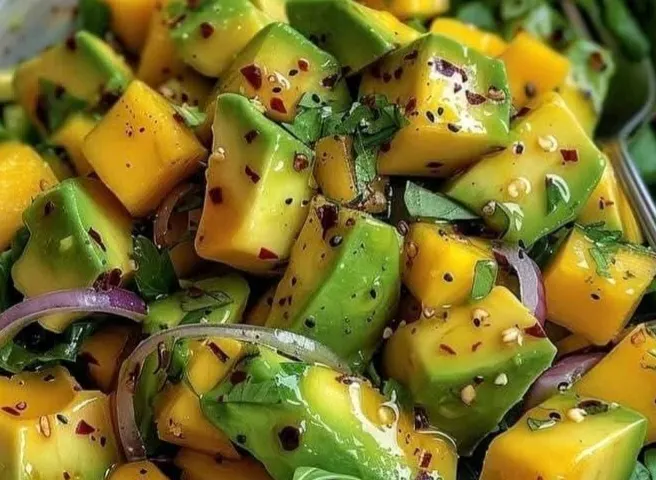
Biltong salad
Snack
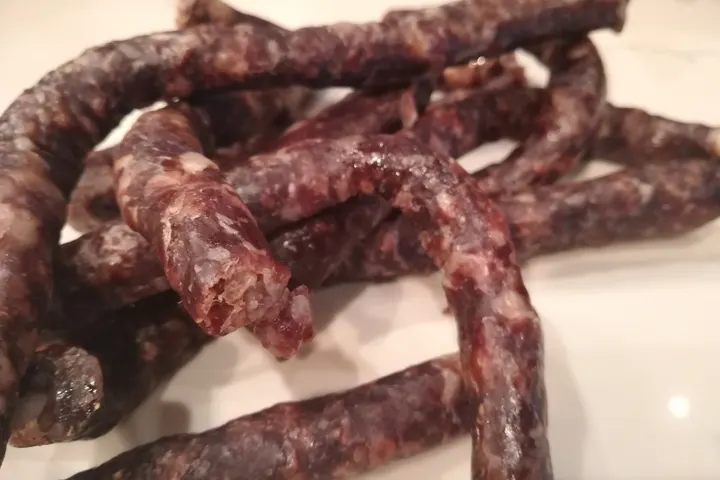
Droëwors
Meat · T-bone tjop
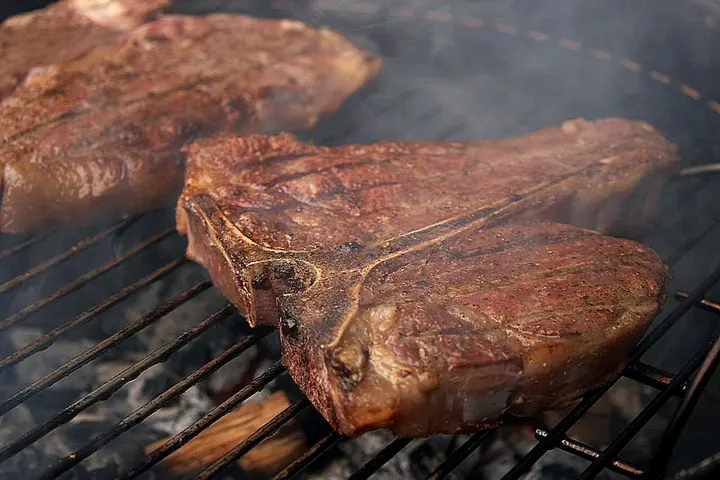
T-bone with braai salt
Snack
Braaipastei
Medium
Snack · Braaipastei