Monograph
Boerewors
The sausage without which there is no braai — and one of the few South African foods whose composition is written into the gazette. What that means exactly, how to spot it at the counter, and what stands in for it in Europe.
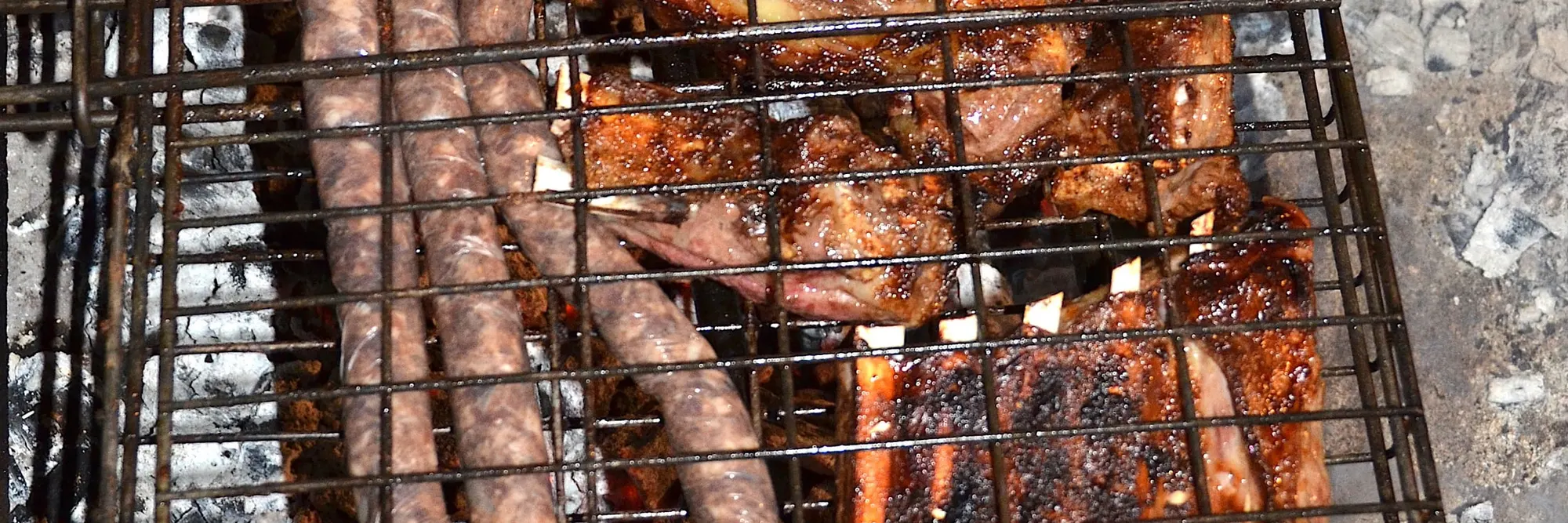
Where the word comes from
Afrikaans boer means farmer, wors means sausage. Literally a farmer’s sausage — and the name carries the first trap for anyone arriving from Europe: a German Bauernwurst is scalded and fine. Boerewors is raw, coarsely cut and coiled in one continuous spiral.
Ask for a farmer’s sausage in a shop abroad and you will almost certainly get something else. What to check for is further down.
What the law says
The reference is Government Notice R. 2718 of 23 November 1990, made under section 15(1) of the Foodstuffs, Cosmetics and Disinfectants Act 54 of 1972 and in force six months after publication. The full text is linked below. Since 26 August 2022 R. 2410 under the Agricultural Product Standards Act sits alongside it, covering classification, packing and marking of raw processed meat products across thirteen categories, boerewors among them.
- Species
- Bovine, ovine, porcine or caprine — or a mixture of two or more.
- Meat content
- A minimum of 90 per cent total meat content. Note: that is fat-free meat together with the fat, not lean meat alone.
- Fat content
- No more than 30 per cent.
- Offal
- None — except the casing, where offal is used solely as the casing.
- Mechanically recovered meat
- Not permitted.
- Casing
- Must be an edible casing.
- Otherwise allowed
- Only cereal products or starch, vinegar, spices, herbs, salt or other harmless flavourants, permitted food additives, and water.
- Label
- The word Boerewors at least 4 mm high on the main panel; in the ingredient list the minimum percentage of meat and the maximum percentage of fat, at least 1 mm high.
- Game
- Game sausage is not boerewors but species sausage, with at least 75 per cent total meat content, of which at least 75 per cent must be the named species.
Sources
- Government Notice R. 2718 vom 23. November 1990 — Composition and labelling of raw boerewors (Volltext, PDF)
- ASC Food Safety — Legislation: raw boerewors, raw species sausage and raw mixed-species sausageSA
- SAMPA — Raw Processed Meat Regulation R. 2410, veröffentlicht am 26. August 2022SA
- ButcherSA — New rules for boerewors in South AfricaSA
Checked on 2026-09-05
The test bench
Six questions you can answer standing at the shelf. The result is a sentence underneath, not a score — and the sheet works printed out.
Without a script this is a printable checklist: six ticks means boerewors. If coriander or vinegar are missing it is a spiced bratwurst — no bad thing, but a different thing.
The regional kinds
No law governs what the names mean — it is trade convention. So every row carries the source the attribution comes from.
| Kind | What is different | How you notice | Source |
|---|---|---|---|
| Grabouw | Mildly spiced, more finely ground spice base, with a share of pork. | Tastes earthy and restrained; the spice does not lead. | Wine Magazine SA |
| Ossewa | Noticeably more clove than usual. | You smell the clove at the grid already. | Mail & Guardian |
| Cederberg | Strongly, sometimes hotly spiced. | Warmth afterwards rather than heat in the mouth. | Mail & Guardian |
| Karoowors | Mostly lamb, savoury and earthy. | The lamb comes through before the spice. | Wikipedia |
| Cape Malay | Sweet spices — cinnamon and cardamom. | Smells like baking, tastes like sausage. | Mail & Guardian |
| Spekwors | Extra cubed pork fat in the mix. | White cubes visible in the cut, and it spits more. | Wikipedia |
| Kameeldoring | Its own spice signature, named after the camel thorn. | Regionally common, the make-up differs by butcher. | Wikipedia |
| Knoblauchwors | Garlic as the leading spice. | You smell it unwrapping it, not at the fire. | Wikipedia |
Why coriander
The spice base is toasted coriander seed with black pepper, clove, allspice and nutmeg, bound with vinegar. Of those five, coriander is the one building block that separates boerewors from every European sausage.
Toasting is not a flourish. Raw coriander seed tastes soapy and lemony; in a dry pan it turns warm and nutty, and that is what carries the fat. Skip the step and you get a sausage that smells of washing powder — and no idea why.
The vinegar does not taste sour in the finished sausage. It drops the pH, holds the mix together, and was originally the preservation. The same logic sits behind biltong.
Buying it in Europe
Meat and meat products cannot be brought in privately from South Africa. Regulation (EU) 2019/2122 prohibits carrying meat and dairy products from non-EU countries in personal luggage; the reason is animal disease, not taste. What you can buy in Europe is made in the EU by the same method.
What the label has to say for it to be wors: coarsely cut beef with fatty pork, coriander in the ingredient list, vinegar, and no binders beyond starch or cereal. If it says only spices where coriander should be, ask — the answer tells you everything.
At a butcher abroad, the most usable order is: coarse beef sausage, 70 to 30 with pork belly, toasted coriander and vinegar, in hog casing, not tied into links.
Sources
- Verordnung (EU) 2019/2122 — Reisegepäck: Einfuhr von Erzeugnissen tierischen Ursprungs
- Zoll — Bestimmungen für die Einfuhr tierischer Erzeugnisse
Checked on 2026-09-05
When it goes wrong
The sausage splits
CauseCoals too hot. The fat runs out, catches, and the casing tears.
What to doWait until the hand test gives you eight seconds. A split wors is always braaied too hot, never too long.
Black outside, raw inside
CauseStraight from the fridge onto full coals.
What to doTake it out half an hour before and start it on the cooler zone.
Dry and crumbly
CausePierced with a fork, or turned too often.
What to doTongs rather than a fork, exactly one turn, and five minutes resting off the grid.
Falls apart when turned
CauseThe coil is not pinned.
What to doPush two skewers crosswise through the spiral before it goes on.
Smells soapy
CauseUntoasted coriander in the mix — only applies to homemade wors.
What to doToast the seed in a dry pan first, until it smells of itself.
Watch this
Linked, not embedded — opening this page contacts no outside server. The time marks jump straight to the moment.
22:58
English
Travel Trails Tastes
How to Make Farm Style Boerewors | My Family Recipe
Shows the whole chain from the counter to the grid. Even if you only ever buy wors, you come away knowing what to look for.
- 2:49„Prepping the meat (70/30 ratio)“ — The ratio of lean beef to fatty pork, shown as whole cuts rather than claimed as a number.
- 12:06„Grinding (8-10 mm plate)“ — The mincer plate. This is where wors parts company with a bratwurst: coarsely cut, not finely emulsified.
- 20:09„Day 2: Boerewors on the coals“ — The coil on the grid — and how slowly it is actually braaied.
Differs from us
In the video the sausage rests uncovered overnight in the fridge. We only call for that with homemade wors — shop-bought comes out half an hour before, and that is all.Last checked 2026-09-05
10:20
English
Wolkberg Artisans
How to make Traditional Boerewors | South African sausage recipe
Forty of its own chapter marks, each labelled with a quantity or a step — closer to an illustrated recipe than a video.
- 0:48„Toast for a few minutes“ — The coriander seed in a dry pan. The one step that separates boerewors from any European sausage.
- 4:04„First grind“ — First pass through the mincer — this is where you see how coarse coarse actually means.
- 4:21„Mix until the meat can form a sticky patty“ — The bind test. If the mix does not stick, the sausage falls apart later.
Last checked 2026-09-05