Side
Chakalaka
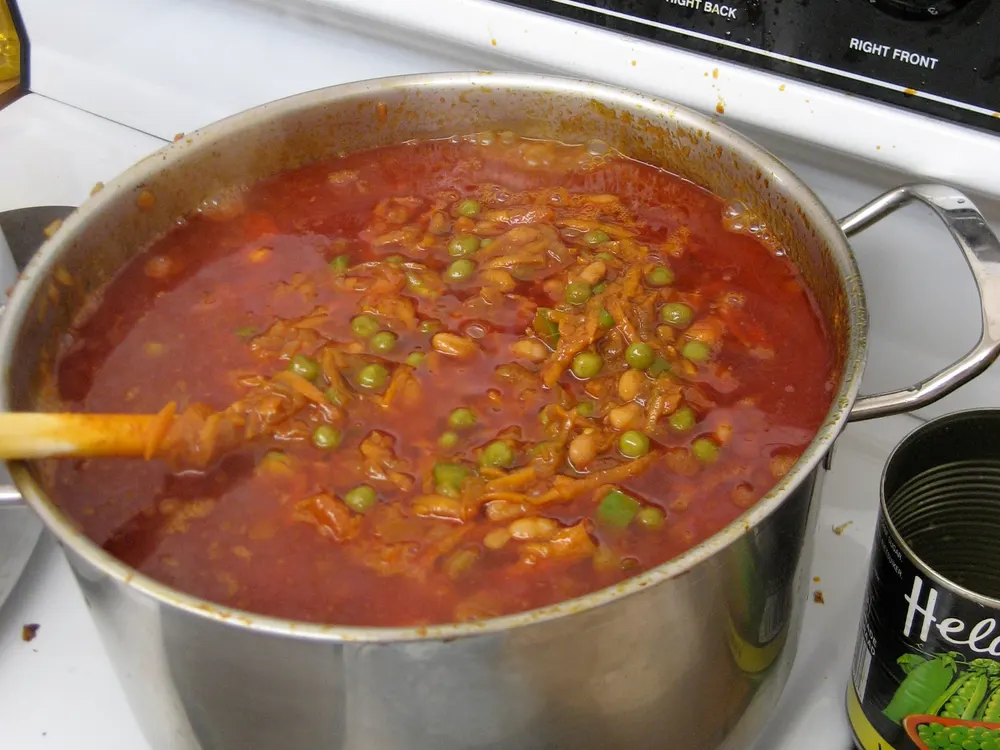
A hot vegetable relish with curry, carrot, peppers and baked beans in tomato sauce. Eaten warm, at room temperature or cold, and served next to the pap rather than on the grid.
Chakalaka came out of the townships and mine hostels around Johannesburg. Mozambican miners cooked what was in tins after their shift — tomatoes, beans — and spiced it up Portuguese style. That became the side dish no braai is without.
- Prep
- 20 min
- On the fire
- 20 min
- Serves
- 6
- Effort
- easy
When it goes on
Done beforehand
Made in the kitchen. On the table before you light up.
Equipment: Cast-iron pan
This line
Braai as a public affair, butchery and fire in one place, fatty cuts, pap and chakalaka as standard.
Method
-
Soften the onion
Heat the oil in a large pan or shallow pot and soften the onion over medium heat for a minute or two.
-
Open the spices in the fat
Add garlic, ginger, curry powder, paprika, cayenne and thyme and stir for a minute until they smell strong. Added dry, curry powder and paprika taste of flour — this is the step that makes the difference.
-
Hard vegetables first
Add peppers and carrot and cook for three to four minutes. Then stir in tomatoes, chilli and cabbage.
-
Five minutes covered
Cook covered over medium heat for five minutes, stirring once or twice. The vegetables should keep some bite — chakalaka is a relish, not a vegetable stew.
-
Beans and paste
Stir in the tomato paste, then add the beans with their sauce. Simmer gently for another five minutes until everything is hot and the sauce has thickened slightly.
-
Season
Salt and pepper firmly, more chilli if you want it. Serve warm, at room temperature or cold — all three are correct.
Tips
- Chakalaka is better on the second day. Cooking for a crowd? Make it the day before and put it on the table cold.
- Heat is a family matter. Leave out the cayenne and fresh chilli for children; the curry stays.
- Leftovers become a filling — cold in a braaibroodjie, or in a split roosterkoek.
Chakalaka is proof that the best side dishes come out of scarcity. It comes from the mine hostels around Johannesburg, where Mozambican workers cooked with whatever kept: tinned tomatoes, tinned beans, some curry powder, plenty of chilli.
Which is exactly why there is no correct recipe. Some families use cabbage, others butternut, others again only carrot and beans. What stays the same in every version is the order: onion, then spices into the fat, then vegetables by cooking time, beans last.
And one detail that often gets lost: chakalaka is not served warm because it has to be warm, but because it has just been made. Cold out of the fridge the next day it is at least as good.
Where it comes from
- Where the word comes from
- Origin unresolved · Literally „no settled meaning“ Usually described as onomatopoeic; there is no documented derivation.
Chakalaka is one of the few South African sides whose ingredient list comes entirely out of tins and packets — and that is not a fallback but the origin. The dish grew up in the townships and hostels around Johannesburg, among mineworkers cooking after a shift and depending on things that keep: tinned tomatoes, tinned beans, curry powder.
The Mozambican share is named in several accounts: migrant mineworkers brought the heat that local cooking had not had. Attributions like that are hard to document for a dish with no written record — the derivation of the name is just as open, and is usually described as onomatopoeic.
What can be said: chakalaka is recent, it is urban, and it is spread across the whole country without there being a canonical version. Every family makes it a different heat, and carrots are obvious in one version and excluded in the next.
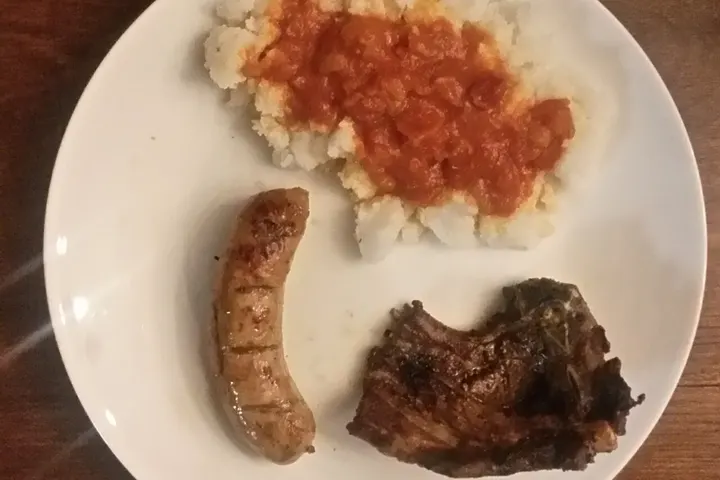
At the fire it has a fixed job: it is the sauce for the pap. And because it is as good cold as warm, it is the one thing on the table that is allowed to be ready before the fire is lit.
Sources for this section
Watch this
Linked, not embedded — opening this page contacts no outside server. The time marks jump straight to the moment.
19:50
English
Travel Trails Tastes
Heritage Day Braai Masterpiece! | Sirloin Steak, Roosterkoek & Chakalaka
Three things in one sequence: bread, side, meat. Shows the order at the fire that this whole site is built around.
- 0:17„Making the roosterkoek“ — The dough before it goes on the grid — the consistency and the size of the pieces.
- 5:27„Preparing the chakalaka“ — Chakalaka built from tins, the way it actually gets cooked.
- 12:14„Roosterkoek on the braai“ — On the last coals, not over full heat. That is where most attempts go wrong.
Last checked 2026-09-05
6:55
English
Wanna Cook
How to Cook Braai Pap | Wanna Cook
The one move where pap fails — adding the meal — shown large.
- 0:55„Add Starter“ — How the meal goes into boiling water without lumping.
- 1:47„Simmer“ — The time you leave the lid on. Stirring makes it worse, not better.
Last checked 2026-09-05
Goes with this
Side · Pap
Pap — stywe pap and krummelpap
Sausage
Boerewors
Meat · Karoo-tjops
Karoo lamb chops
Fish · Calamari op die kole