Meat
Bunny chow
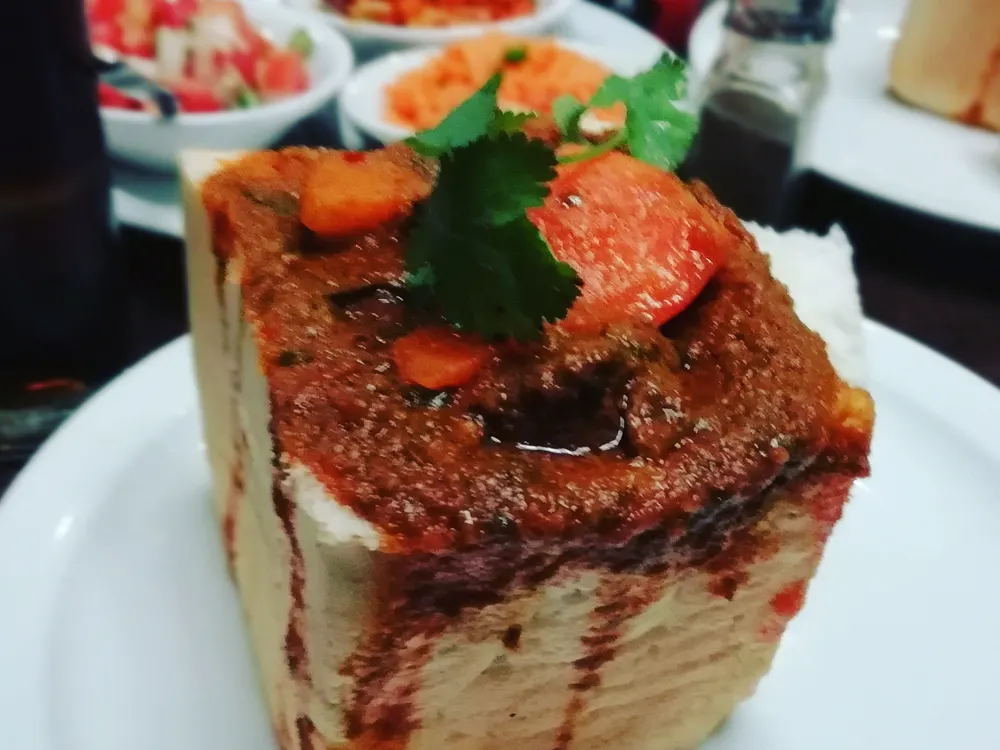
A fiery Durban lamb curry in a hollowed-out quarter loaf of white bread. No plate, no cutlery — the bread is both, and it gets eaten at the end.
Bunny chow arose in 1940s Durban among Indian South African workers who needed a portable meal. Bunny probably comes from bania, the merchant caste that sold it; chow simply means food. Rabbits are not involved.
- Prep
- 35 min
- On the fire
- 1 hr 45 min
- Serves
- 4
- Effort
- medium
When it goes on
Done beforehand
Made in the kitchen. On the table before you light up.
Equipment: nothing
This line
Curry as everyday food, bread as a vessel, the curry powder on the supermarket shelf.
Method
-
Toast the whole spices
Heat the oil and fry the cinnamon stick, cardamom and curry leaves briefly until the leaves crackle. That is the base everything else is built on.
-
Brown the onions
Add the onions and fry over medium heat for 12 to 15 minutes until deeply golden. Do not shorten this — a Durban curry gets its colour from the onions, not the powder.
-
Ground spices
Add garlic, ginger and chilli for a minute, then stir in masala and turmeric and deglaze with a splash of water so they do not catch.
-
Seal the meat
Add the lamb and stir until it has taken colour all over.
-
Braise
Add tomatoes, water and salt, bring to the boil and braise covered on low heat for an hour and a half. Add the potatoes after an hour.
-
Reduce
Take the lid off and reduce for 15 minutes until the sauce is thick and oil settles on the surface. That is the point at which a Durban curry is finished.
-
Prepare the bread
Quarter the loaf. Take the crumb out of each quarter from the cut side without piercing the crust. The removed piece is called the virgin and goes alongside for dipping.
-
Fill and serve
Spoon the hot curry into the bread quarters, scatter with coriander and serve with carrot sambal — coarsely grated carrot with chilli, vinegar and salt.
Tips
- The bread must be dense. An airy ciabatta dissolves; a plain square white loaf holds for an hour.
- The curry must be thick. If it is still loose, the base goes through before the first mouthful.
- You eat it with your hands: dip the removed crumb first, then work through the walls. Cutlery is not part of the plan.
- Bunny chow comes as a quarter, a half or a whole. A quarter is a meal for one person, not a starter.
Bunny chow is not a kitchen invention but a logistical one. In 1940s Durban, Indian South African workers needed something they could carry, take with them and eat without a plate. A hollowed-out quarter loaf solved all three at once.
That makes it the only dish on this site with nothing to do with fire that still belongs here — because it is as South African as boerewors, and because Durban curry is a chapter of its own: more chilli, more turmeric and less cream than any northern Indian version.
The critical thing is consistency. A bunny chow stands or falls on whether the sauce is thick enough. If it is not, you have curry in your lap after five minutes and a loaf with no floor.
Where it comes from
- Where the word comes from
- South African English · Literally „probably from *bania* (merchant caste) and *chow* (food)“ It has nothing to do with rabbits.
On 16 November 1860 the Truro docked at Port Natal with 342 indentured workers from Madras aboard. By 1911 some 152,000 people had come from India under indenture to work the sugar estates in Natal — five years for ten shillings a month. In 1911 India stopped the traffic over the treatment of its nationals.
Those who stayed after their contracts ran out often opened a small shop or a street stall. Those stalls are where the dish Durban is known for comes from: curry in a hollowed loaf, eaten with no plate and no cutlery.
The dating is unsettled. The 1860s are named for the first curries served in disposable containers, the 1930s and 1940s for the hollowed loaf in its present form. Both stand here, because neither date can be pinned down.
What has stayed is the construction. The bread is not a container but part of the meal: the crumb taken out — the virgin — sits on top and is used for dipping. Throw it away and you have thrown away half of it.
Goes with this
Sauce
Sheba

Sweet
Melktert
Fish · Calamari op die kole